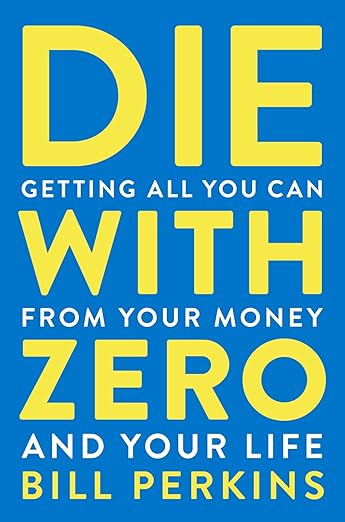
There is a particular kind of financial success story that rarely gets questioned: the person who dies at 87 with €2 million in the bank, having spent the last decade too frail to travel, too cautious to spend, and too habituated to saving to change. By most conventional measures, they did everything right. Bill Perkins thinks they did something profoundly wrong.
His 2020 book Die With Zero is not a book about spending recklessly. It is a book about a specific, underappreciated failure mode — the person who works hard, accumulates diligently, and then dies with vast untapped wealth that could have funded decades of meaningful experiences while they were still healthy enough to enjoy them.
The central premise is uncomfortable but difficult to dismiss: money only has value if it is converted into something — experiences, memories, impact, relationships. Left unconverted, it is simply life energy you traded away and never reclaimed.
"Your life is the sum of your experiences. Everything you do adds up to who you are — and when you look back, the richness of those experiences will determine your judgment of how full a life you led."
1. The memory dividend
Perkins introduces a concept he calls the memory dividend. When you spend money on a meaningful experience — a trip with your children, an adventure with old friends, a course that changes how you think — you do not simply consume that money. You invest it in a memory that compounds for the rest of your life.
Every time you recall the experience, share it with someone else, or have it shape a decision, it pays a return. Unlike a car that depreciates or a gadget that becomes obsolete, a good memory tends to appreciate. The value of a family trip taken when your children were young grows richer every time you talk about it twenty years later.
The implication is significant for FIRE planning: the return on a well-timed experience may exceed the return on a well-invested euro — particularly if that euro sits in a pension fund waiting to be withdrawn when you are 75 and less physically capable of the experience you had in mind.
2. Time buckets — not all experiences age well
One of Perkins's most useful practical frameworks is the idea of time buckets. Rather than thinking of retirement as a single destination you prepare for, he suggests dividing your life into rough phases and asking honestly: what experiences are best suited to each phase?
This framework reframes the whole logic of deferred gratification. Waiting until retirement to do everything you postponed assumes that your 70-year-old self will want, and be able to do, everything your 40-year-old self wanted. In most cases, that assumption is false — both physically and in terms of what actually brings fulfilment.
3. Your peak worth — when to stop accumulating
Perkins introduces a concept he calls peak worth: the point at which you should stop prioritising wealth accumulation and start converting that wealth into experiences. Most people never consciously identify this point. They simply continue the habits of accumulation long past the point where additional savings produce meaningful security or wellbeing.
The FIRE community, in particular, is susceptible to what might be called over-optimisation for the destination at the expense of the journey. An obsessive focus on reaching a number can cause people to defer experiences that would have been most valuable in the years spent working toward that number.
This does not mean FIRE is wrong. Perkins is not arguing against financial independence. He is arguing that financial independence is a means to an end — and that the end should be a life rich in experiences, not a balance sheet that never gets fully deployed.
4. Give with a warm hand
Traditional inheritance planning assumes you accumulate wealth throughout your life and distribute it after your death. Perkins challenges this as poorly timed generosity. A €50,000 inheritance received at 55 does far less good than the same amount received at 28 — when it might fund a business, a home deposit, further education, or a period of risk-taking that would otherwise be impossible.
He calls this giving with a warm hand — transferring wealth to children or causes while you are alive to witness its impact. The joy of seeing your gift put to work is itself a form of return. The recipient benefits more. The estate process is simplified. And the money avoids the tax and delay that typically accompany post-death transfer.
5. Health is the multiplier — spend it wisely too
A theme that runs through the book but often gets overlooked in summaries: health is not separate from the financial equation. It is the multiplier that determines how much enjoyment you can extract from any given amount of wealth. A person with €500k and excellent health at 55 is in a fundamentally different position than a person with €1 million and failing health at 70.
Perkins argues this makes spending on health maintenance at the front end of life among the highest-return investments available. Not the heroic end-of-life medical spending that extends a deteriorated existence by months, but the preventive investment in fitness, nutrition, sleep, and stress management that extends the window of active, capable life by years or decades.
This is where Die With Zero connects directly to planning tools: your life expectancy is not a fixed number. It is a variable you influence continuously, and it directly determines how long your money needs to last and what experiences remain available to you.
The honest critique
Any serious engagement with the book has to acknowledge its limitations. Perkins is a billionaire hedge fund manager who has never had to worry about running out of money. His position makes it easy to advocate for spending; the downside risk is not symmetrical for most people.
The book also underweights the psychological difficulty of changing savings habits that took decades to build. And it is silent on the very real possibility of extended periods of costly care at the end of life that can exhaust savings faster than any financial model predicts.
But these caveats do not invalidate the core insight. The book is not telling you to spend recklessly. It is asking you to spend deliberately. To make conscious choices about when and how to convert the wealth you have worked for into the life you actually want — rather than deferring indefinitely on the assumption that a richer future self will enjoy it more.
No one gets an award for having the most money in their grave. The goal is not maximum wealth at death. The goal is maximum life between birth and death.
What this means for your FIRE plan
If you are pursuing financial independence, Die With Zero is a useful counterweight to the conventional optimisation mindset. A few questions worth sitting with:
Are you deferring experiences that belong to this decade, not the next? The trip you are waiting to take until you retire may be a different and lesser trip by the time you actually take it.
Do you know your peak worth — or just your FIRE number? The FIRE number tells you when you can stop working. Peak worth tells you when additional accumulation starts costing more in deferred life than it adds in security.
Is your giving timed for impact? The people and causes you care about may benefit far more from your generosity today than from an estate distribution decades from now.
Are you investing in health as a multiplier? The number of years in which your wealth can be fully enjoyed depends enormously on decisions you make now about how you live.
Then find out how long it needs to last.